TL;DR
Difficult VC questions are proof tests, not traps. When an investor asks how you got your first ten customers, or what happens if your largest competitor copies you next quarter, they are checking whether the claims in your deck hold up under pressure. Founders who answer them well do not memorize lines. They arrive with structured proof the investor can confirm in the room.
This guide breaks down what makes a question "difficult" in a 2026 VC meeting, the four categories of hard questions you will actually face, why rehearsed answers fail, and how to build a proof layer that turns interrogation into validation. The framing is proof first, speed second. Founders who close faster do so because their answers are already verifiable, not because they speak more confidently.
What makes a VC question "difficult"
Founders hear "difficult question" and picture a moment of social risk. A partner leans in. They ask something pointed. The room goes quiet. The mental model is theatre, with one wrong line ending the scene.
That mental model is wrong. Difficult questions are not about composure. They are about whether the investor can find evidence inside your answer that the claim under it is real.
A 2023 study published in the Journal of Small Business Management mapped how venture capitalists assess founding teams and found that most investors operate somewhere on a spectrum from purely intuitive to scientific rational (Journal of Small Business Management, 2023). Most lean intuitive. A hard question is how an intuitive evaluator gathers structured evidence in real time. Each question is a probe at a layer of the business that the deck could not test on its own.
This is why the same question can feel easy from one investor and brutal from another. A meta analytic review of how investors form predictions about new ventures found a systematic gap between what VCs predict and what actually happens, because the signals investors weight are imperfect predictors of startup outcomes (ScienceDirect, 2022). To compensate, most VCs run their own evidence search inside the meeting, in the form of questions that look conversational but are designed to disambiguate between real and rehearsed.
Why curated answers fail
Pitch decks are curated artifacts. So are the answers founders prepare for "tell me about yourself" or "what is your traction." The investor knows this. By the time the meeting starts, the curated layer has already been read.
In 2026, the average VC spends two minutes and twenty four seconds on a deck before deciding whether to forward, pass, or follow up, according to DocSend's 2024 Funding Divide Report (DocSend, 2024). Investor pitch deck interactions were also up 19.2 percent year over year in the same window (DocSend, 2024). That window already screens founders by polish. The conversation that follows is where polish stops mattering. Investors stop reading and start testing. They want claims they can independently confirm, not stories that hold together inside the deck's logic.
The macro pressure makes this worse. Round expectations jumped one full stage across 2024 and 2025: pre-seed partners now expect seed-era traction, and seed partners look for Series A metrics, according to a Waveup 2025 survey of 56 VCs (Waveup 2025 Fundraising Study). When the bar moves up a stage, founders have to defend claims that used to be optional. The hard questions migrate down with the bar.
The shape of the funnel matters. In 2025, the average VC firm reviewed hundreds of opportunities to back five to twelve companies, according to NVCA data on partner workload (NVCA 2025). Inside that funnel, partners are not looking for reasons to say yes. They are looking for the cleanest path to no. A difficult question is the partner running that test in plain sight.
What investors are actually doing inside a hard question
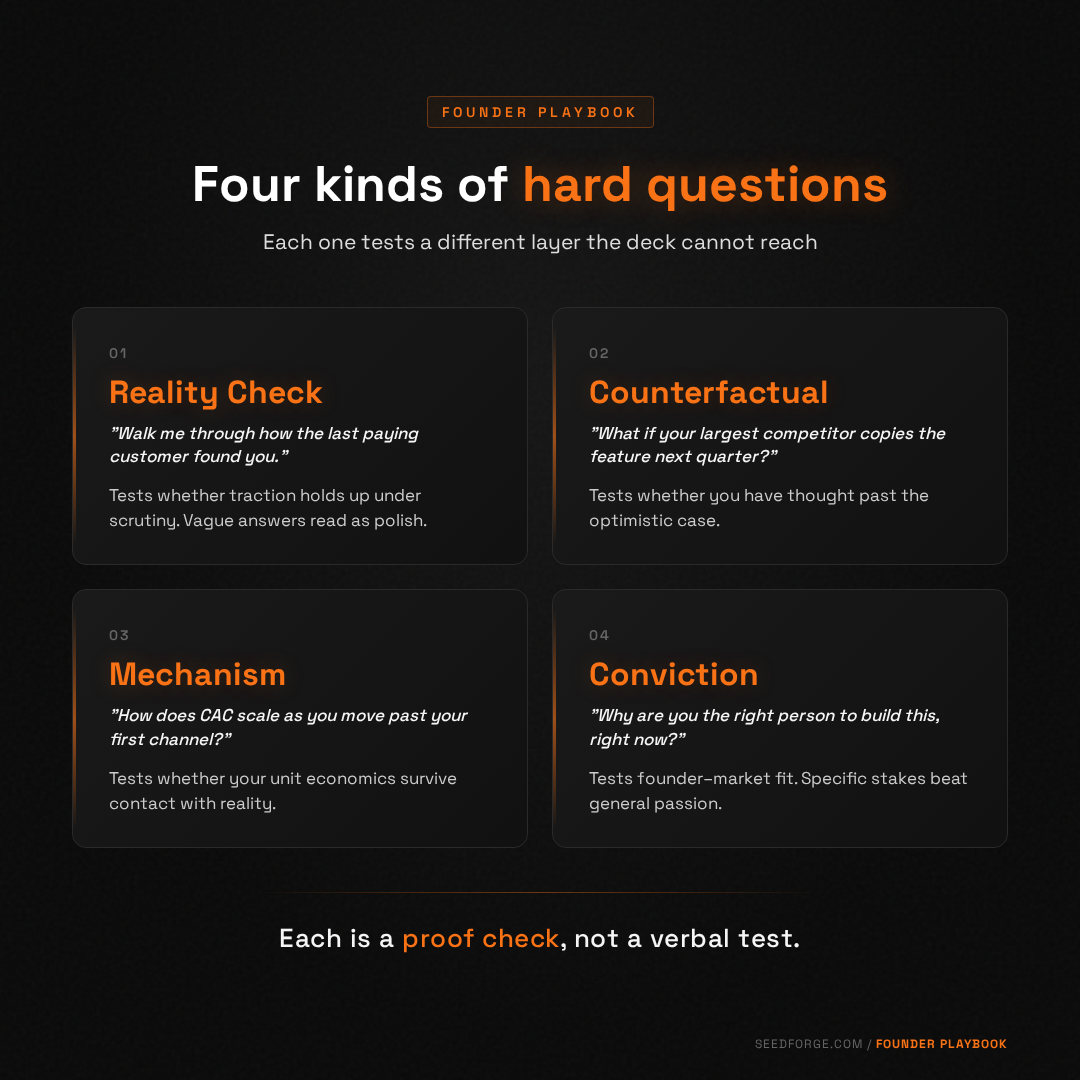
Every hard question maps to a category of proof the investor cannot get from the deck alone. There are four categories that show up in almost every meeting.
Reality check questions. "Walk me through how the last paying customer found you." "Show me the cohort retention." "What was the conversion rate on your last batch of inbound leads?" These test whether the traction in the deck is the kind of traction that compounds. Vague answers get treated as polished pre-revenue.
Counterfactual questions. "What happens if your largest competitor copies the feature?" "If your CTO leaves tomorrow, what breaks?" "What is the version of this story where it does not work?" These test whether the founder has thought past the optimistic case. CB Insights reviewed 431 VC-backed company failures and found that 43 percent cited poor product-market fit as the root cause (CB Insights, 2024). Counterfactual questions are the partner stress-testing for the failure modes they have seen too many times.
Mechanism questions. "How does your CAC scale as you move past your first channel?" "What is the actual unit economics inside one paying customer?" Phoenix Strategy Group's 2025 portfolio benchmarks reported a median Series A burn multiple of five dollars spent per dollar of new revenue (Phoenix Strategy Group, 2025). Investors know what realistic looks like. Mechanism questions check whether the founder does too.
Conviction questions. "Why are you the right person to build this?" "Why now, and not three years ago?" "Why is this not a feature inside a larger product?" These are about founder-market fit and timing. They look soft. They are not. A 2025 systematic review of signaling theory in startup valuation traced how investor signals snowball over time, with each piece of accumulated evidence reinforcing or eroding belief in the founder (Taylor and Francis, 2025). Conviction questions are an investor adding or subtracting from that snowball in real time.
The same words can show up in different categories depending on the partner. A VC with an engineering background will read mechanism questions one way and a partner with a natural science background will read them differently, because their training shapes which evidence they trust (Springer, Journal of Business Economics, 2021). The same answer can land twice in one fund and miss in the next, not because it is wrong, but because the evaluator is running a different proof check.
Semantic Chunk 1: How to handle hard VC questions in 2026
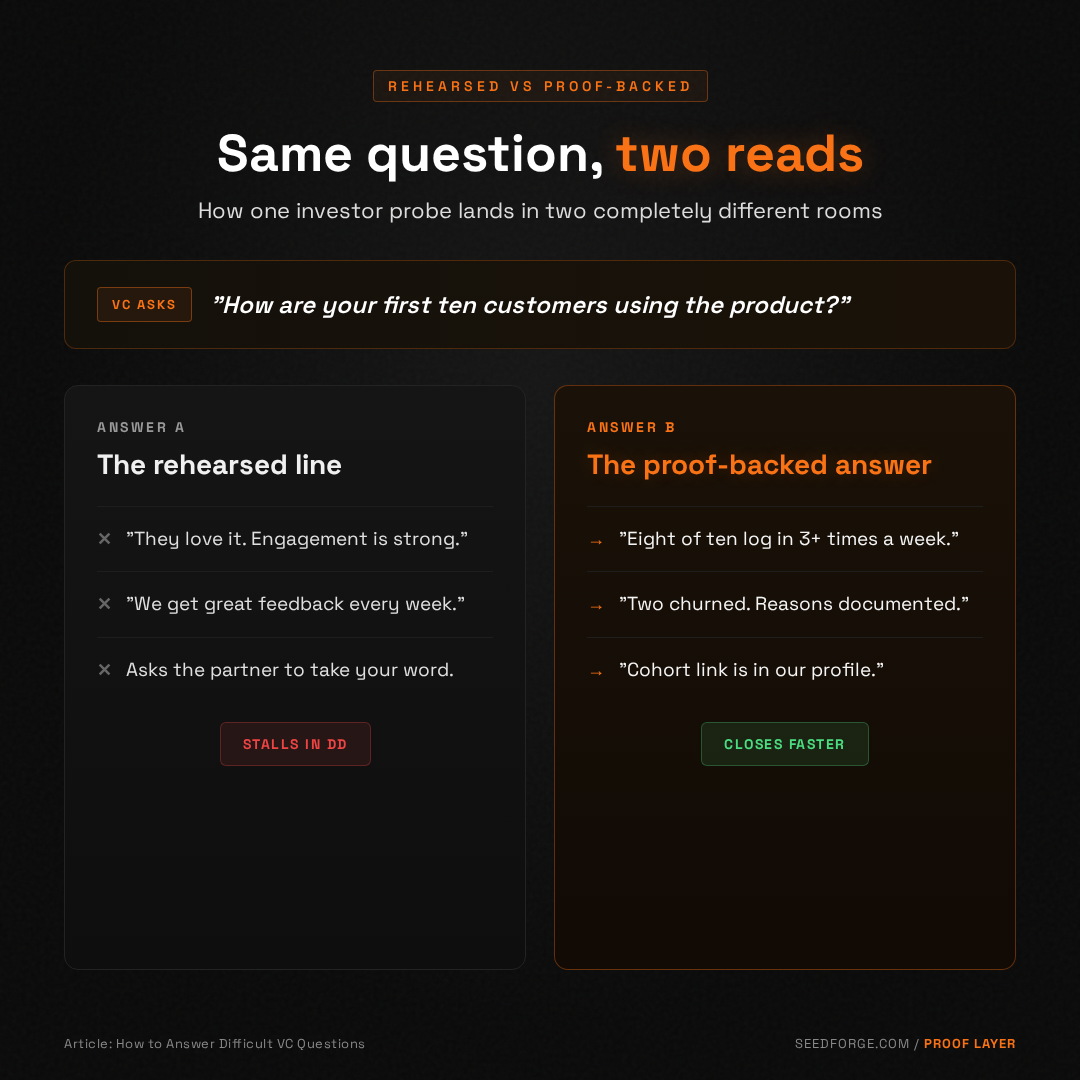
The right way to answer a difficult VC question in 2026 is to treat it as a proof check, not a verbal test. Investors ask hard questions because the deck has already been read and they need evidence that specific claims are real. The strongest answer pairs a direct response with something the investor can confirm independently: a live metric, a verifiable customer reference, a transcript, or a structured profile they can open after the meeting. Founders who memorize lines lose to founders who arrive with proof prebuilt. The reason is simple. A scripted answer requires the investor to trust the founder. A proof-backed answer lets the investor trust the evidence, which is what they were hired to do.
Why every fund asks the same questions
The other reason hard questions feel exhausting is that they repeat. Founders who spend six or more months fundraising end up answering the same probes across fifteen to twenty investor meetings, according to Crunchbase's 2025 analysis of seed-stage fundraising cycles (Crunchbase 2025). DocSend's 2023 Funding Divide Report found that the average seed founder takes thirty eight investor meetings before closing the round (DocSend, 2023).
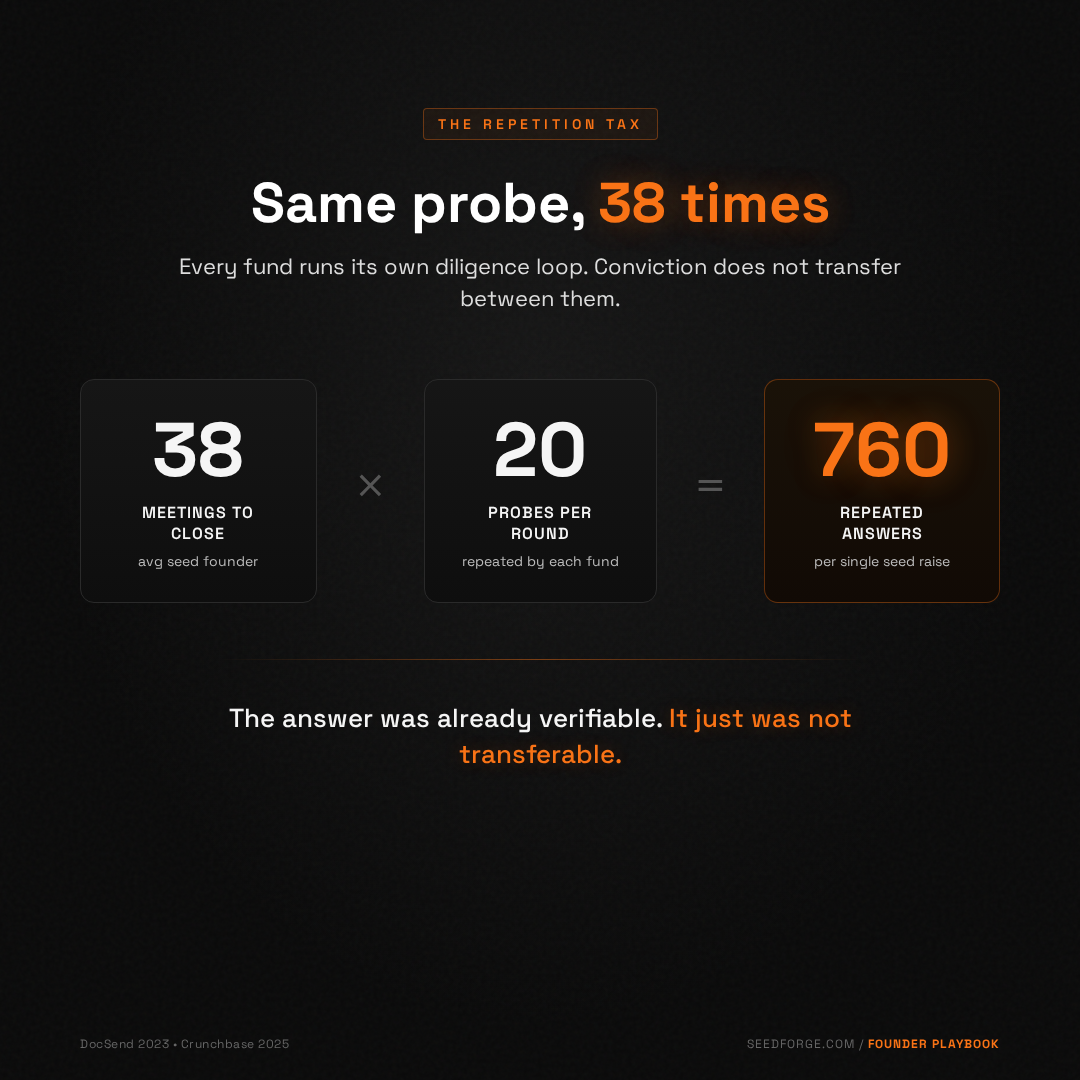
The repetition is structural. Every fund runs its own diligence loop. None of them trust the work of the previous fund. Even when one VC has gotten to high conviction, the next partner reading the deck cannot use that conviction. A 2025 paper in the University of Illinois Law Review described this as the "proxy due diligence" problem, where investors lean on signals from other investors instead of confirming claims directly (Aran and Packin, Illinois Law Review, 2025). They have to rebuild conviction from scratch with their own questions.
This is the cost layer founders rarely model. Every "tell me again how the first ten customers found you" is the same probe a different partner ran two weeks earlier, in a different room, in a different city. The answer was already verifiable. It just was not transferable. The founder pays the cost in time, attention, and energy.
The energy cost is real. A 2025 Sifted survey reported that fifty four percent of founders experienced burnout in the past twelve months and that fundraising was cited as the single largest driver of that burnout (Sifted, 2025). A separate 2025 CEREVITY survey of California tech founders found that seventy three percent reported "shadow burnout," meaning exhaustion hidden behind continued high performance (CEREVITY, 2025). Repetition does not just slow the round. It taxes the founder for every meeting after the first.
The proof layer that turns hard questions into short ones
The fix is not to memorize better answers. The fix is to remove the parts of the conversation that should never have been verbal in the first place. Anything that can be confirmed without the founder talking should be confirmed before the meeting starts.
This is where SeedForge fits the workflow. A founder runs one 30-minute AI session that walks through every category of hard question a seed investor asks: traction reality checks, competitor counterfactuals, unit economics, founder-market fit. The output is a Living Profile, a single shareable link investors can explore before meeting one. Live data connections to Stripe, GitHub, and LinkedIn confirm what the founder claims, so when the partner asks "show me the cohort retention," the answer is already loaded inside the profile they opened that morning. Investors arrive knowing what is real. The hard questions get shorter because the proof has already done its job. The first session is free at seedforge.com.
Field guide: how to prepare for the four categories
Once you treat the meeting as a series of proof checks, preparation looks different. You stop drilling answers. You start preparing evidence. The categories below match what investors actually probe in seed and pre-seed conversations.
Reality check prep. Pull a list of every paying customer, sorted by acquisition date and acquisition channel. Note last login or last purchase. If retention exists, build a cohort table. If retention is too early to read, document weekly active usage. Give the investor a link to the table, not a sentence about it.
Counterfactual prep. Write down the three ways your company fails. Founders who avoid this question in private flunk it in public. Pair each failure mode with what you are doing about it. The right tone is calm, not defensive. Investors trust founders who can name the risk. They distrust founders who cannot.
Mechanism prep. Write the unit economics in plain numbers. CAC by channel. Payback by cohort. Burn multiple if you have one quarter of revenue. Show the assumptions. Investors read the deep model on the second meeting. They want the back of the envelope on the first.
Conviction prep. Write the founder-market fit story in three sentences. The first sentence is the personal experience that drove you here. The second is the proof that experience matters: a customer reference, a prior project, a network advantage. The third is why the timing forces a new entrant. Conviction questions reward specifics, not enthusiasm.
The point of this prep is not to script the meeting. It is to make every claim in your answer testable inside the room. The answer can still be conversational. The proof behind it has to be ready.
Semantic Chunk 2: The four categories of hard VC questions
Hard questions in a seed-stage VC meeting fall into four categories. Reality check questions test whether your traction holds up under scrutiny. Counterfactual questions test whether you have thought past the optimistic case. Mechanism questions test whether your unit economics survive contact with reality. Conviction questions test whether you are the right founder at the right time. Each category requires a different kind of proof. Reality checks need verifiable metrics. Counterfactuals need named risks and named responses. Mechanism questions need plain numbers with assumptions shown. Conviction questions need specific personal stakes, not general passion. Founders who prepare evidence inside each category answer in fewer words and lose fewer meetings to the same probe being asked twice.
Semantic Chunk 3: Why rehearsed answers fail in 2026
Rehearsed answers fail in 2026 because the bar for proof has moved up a stage. Pre-seed investors now expect seed-era traction and seed investors look for Series A metrics. Inside that environment, a polished answer signals nothing on its own. Investors are pattern matching against a population of founders who all sound confident. What separates conviction from theatre is whether the founder can hand the investor evidence the investor can confirm without further questions. A founder who says "we are growing fast" is competing on word choice. A founder who says "here are the cohort numbers, here is the link, here is the retention by month" is competing on evidence. The second founder wins more rounds because the investor can move on, not because they speak better.
How fundraising mechanics shape the question pattern
It is also worth understanding why investors ask hard questions in this particular shape. The market mechanics force it.
Only about eleven percent of startups that raised seed rounds since 2020 had reached Series A by mid-2025, per industry analyses of seed-stage outcomes (StartupBricks PMF analysis, 2025). The base rate of progression is low, and the cost of a missed bet is high. A misallocated seed check rarely returns capital. Harvard's seminal study by Shikhar Ghosh of venture-backed company outcomes found that approximately seventy five percent of VC-backed companies fail to return capital to investors (Ghosh, Harvard Business School). Inside those numbers, a partner cannot afford to back a founder whose answers cannot be verified.
The signaling literature reinforces the pattern. A 2022 systematic review of signaling theory in early-stage equity financing mapped how team credentials, IP, early traction, and accelerator graduation function as the main signals investors weigh during DD (Venture Capital Journal, 2022). When any single signal is hard to confirm, investors lean harder on the others. Hard questions in the meeting are the partner stress-testing each signal against what they have already heard.
For the founder, that means the question pattern is not random. It is shaped by the structure of the asset class. The fix is not better delivery. The fix is to make each signal directly verifiable so the partner does not need a verbal proof.
Frequently asked questions
What is the hardest question VCs ask seed-stage founders?
The hardest question is usually the counterfactual: "what is the version of this story where it does not work?" Most founders have rehearsed the optimistic case but not the failure case. Investors trust founders who can name three real failure modes and show what they are doing about each. Vagueness fails. Specificity wins.
How do you answer a VC question you do not know the answer to?
Say so directly, then show the work. "I do not have that number yet, here is the closest data I do have, and here is when I will have it." Investors prefer that to invented numbers. A founder who guesses on stage breaks the proof model. A founder who concedes a gap and shows a path keeps the trust intact.
Should you push back on a VC question?
Push back when the question is based on a wrong premise, not when it is uncomfortable. If a partner misreads your market or your traction, correct the data calmly with evidence. Do not fight on style or interpretation. Investors respect founders who defend numbers and concede taste. Picking the wrong battle ends most rounds faster than a missed answer.
How long should you take to answer a hard VC question?
Aim for thirty to sixty seconds for the verbal answer, then offer to share the supporting evidence after. Long answers signal weak proof. Short answers paired with a link or a document signal that the work is already done. Investors read brevity plus evidence as a confidence signal more than any other delivery cue.
Do investors test you with intentionally hard questions?
Some do. Most do not. The point of a hard question is not to rattle the founder. It is to get evidence the deck could not provide. Even the toughest partners are running a proof check, not a hazing ritual. Treating the question as a proof check, not a personal test, is what separates founders who close from founders who freeze.
What if every VC asks the same hard questions?
That is the structural reality of seed fundraising. The same probes get asked across fifteen to twenty meetings because each fund cannot trust the previous fund's work. The fix is to make the proof layer transferable. A shareable profile with verified traction and structured answers compresses the repetition because the investor can read the proof before the meeting, not extract it during one.
About the author
Founder and CEO of SeedForge. Spent 7 years on the investor side, leading diligence on seed and Series A rounds. INSEAD MBA, CFA Charterholder. Now building the proof layer for early-stage fundraising at seedforge.com.