
Last updated: August 20, 2026. This update removes four warm-intro statistics attributed to a source that does not publish them, corrects a misstated gender-bias figure and its attribution, replaces two unverifiable timeline claims with figures read at source, and adds a working outbound link to every named source.
The right VC for your startup is the one whose thesis, stage focus, and check size already match what you are building. Most founders skip this step. They pitch broadly, hope for chemistry, and learn that investor fit is a proof problem, not a volume problem.
The founders who close faster do not pitch more investors. They pitch the right ones, with proof already in hand.
The scale of the waste is measurable. DocSend's 2023 seed fundraising research, built on 170 seed pitch decks, found the average seed founding team contacts 66 investors and schedules 38 meetings during a raise, against 48 investors contacted the year before. More outreach bought no extra meetings. Fundraising has got harder in particular for founders who treat it as a volume game, and targeting precision is now the single biggest lever between a six-week raise and a two-year grind.
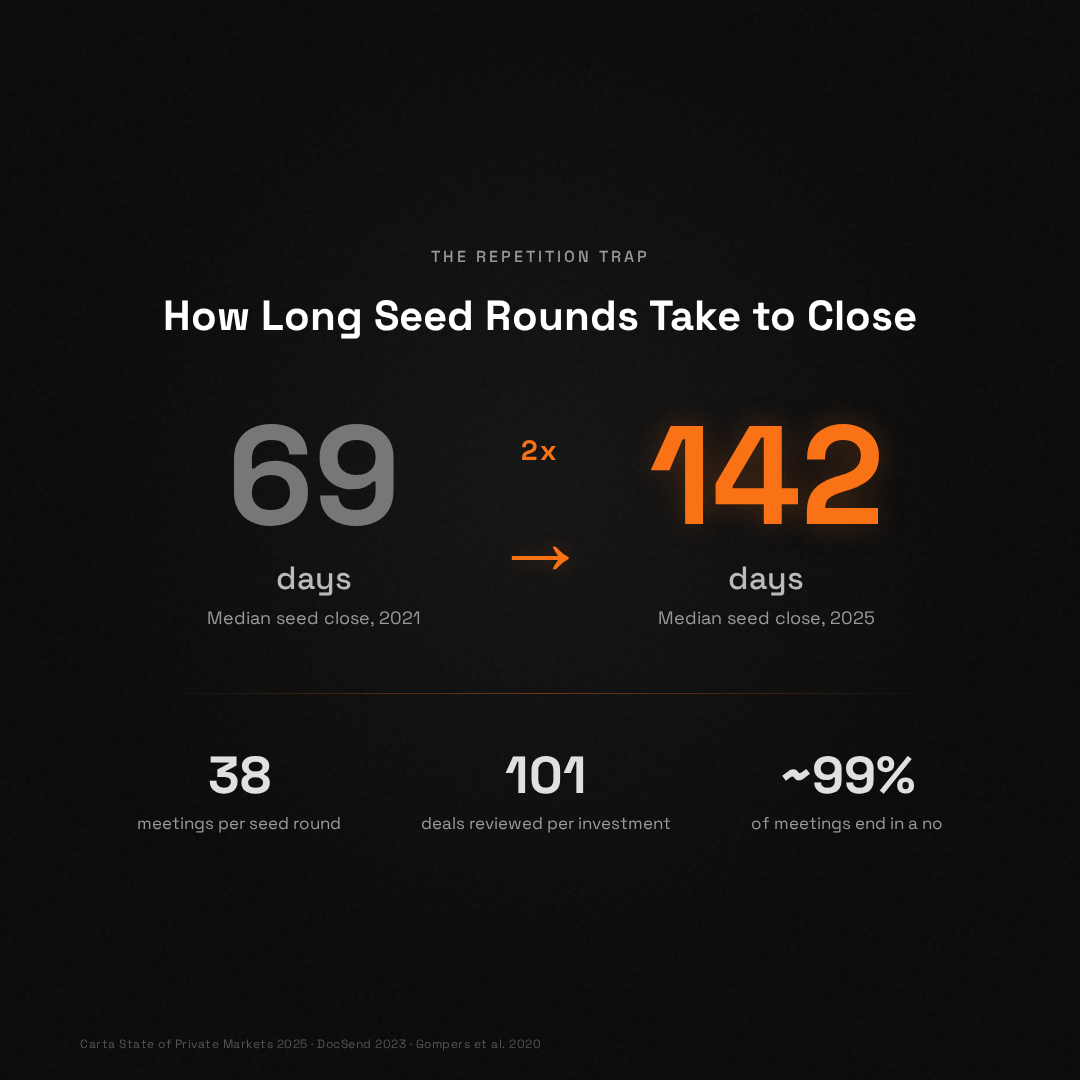
I spent 7 years on the investor side leading due diligence. The pattern was always the same. The founders who showed up with clear thesis alignment and pre-built proof closed in weeks. Everyone else ground through months of meetings that were never going to convert.
Why Pitching Broadly Fails
Most founders treat fundraising like a numbers game. Build a list of 200 investors. Send cold emails. Book as many meetings as possible. Hope that volume converts to a term sheet.
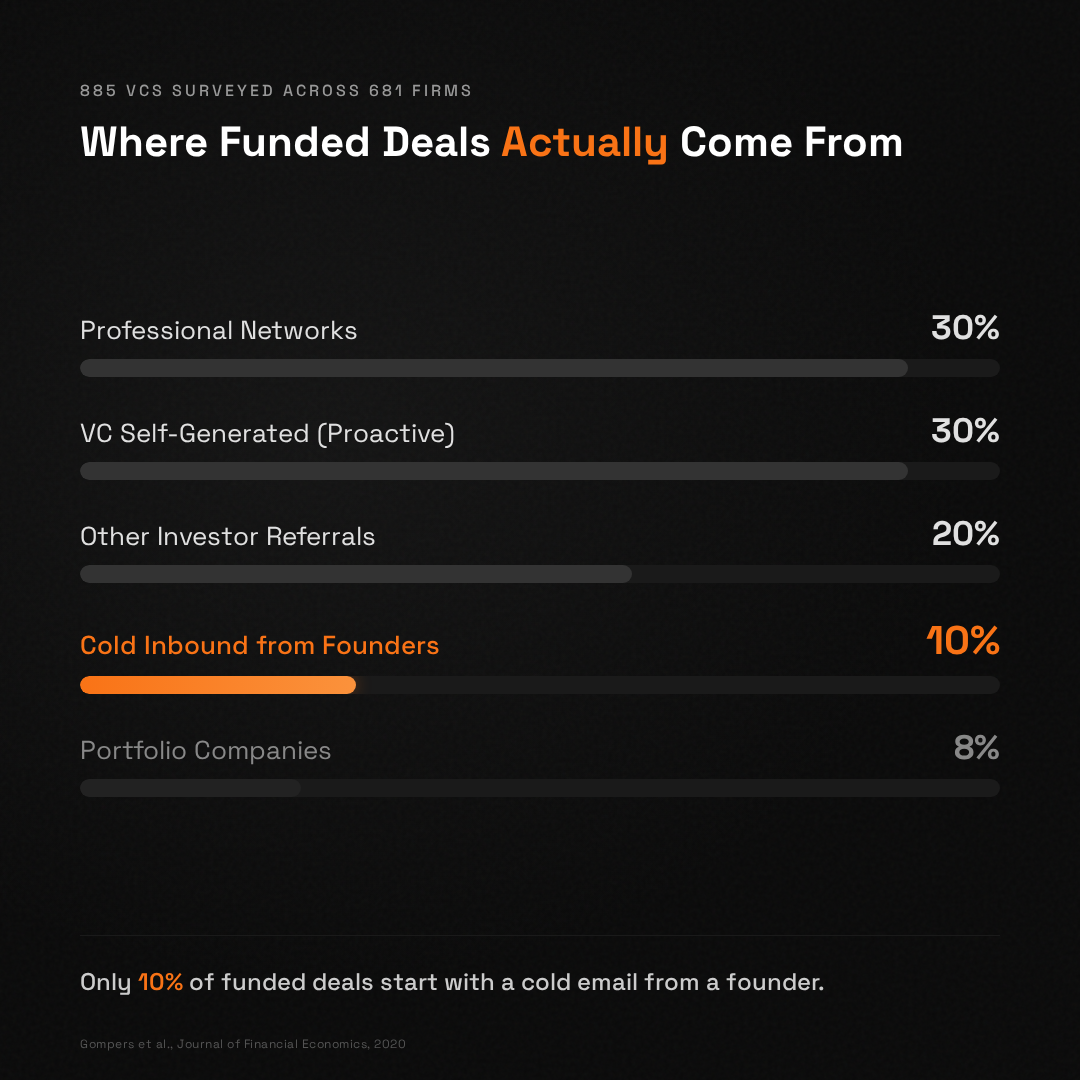
The data says otherwise.
A survey of 885 institutional VCs across 681 firms (Gompers, Gornall, Kaplan and Strebulaev, Journal of Financial Economics, 2020) mapped where funded deals actually come from. About 30% are sourced through professional networks. Another 30% are proactively self-generated by VCs hunting for deals. 20% come from referrals by other investors. 8% come through portfolio companies. Only 10% arrive as cold inbound from founders. Cold outreach to misaligned investors is the lowest conversion channel in venture capital, and the survey puts a number on how narrow it is: inbound from company management is the smallest of the five sourcing channels.
Founders who blast 200 cold emails are competing for the thinnest slice of the funnel, against every other founder using the same channel, while the large majority of funded deals arrive along a network path that somebody had to build first.
Here is what that looks like from the investor side. Most thesis mismatches get sorted out while the investor is scrolling through the deck. They just pass and never reply. A clear thesis mismatch is one of the most common reasons for ghosting. But sometimes the mismatch is borderline. The investor hops on a call, realizes mid-conversation that it is not a fit, but stays on the call anyway, acts polite, maybe offers some advice, and then passes immediately after hanging up.
The investor loses 30 minutes. But the founder, unless they got a clear signal, might spend days or weeks chasing that investor with follow ups into a void. This is why thesis mismatches are so expensive. The cost is asymmetric. The investor moves on. The founder does not know they should.
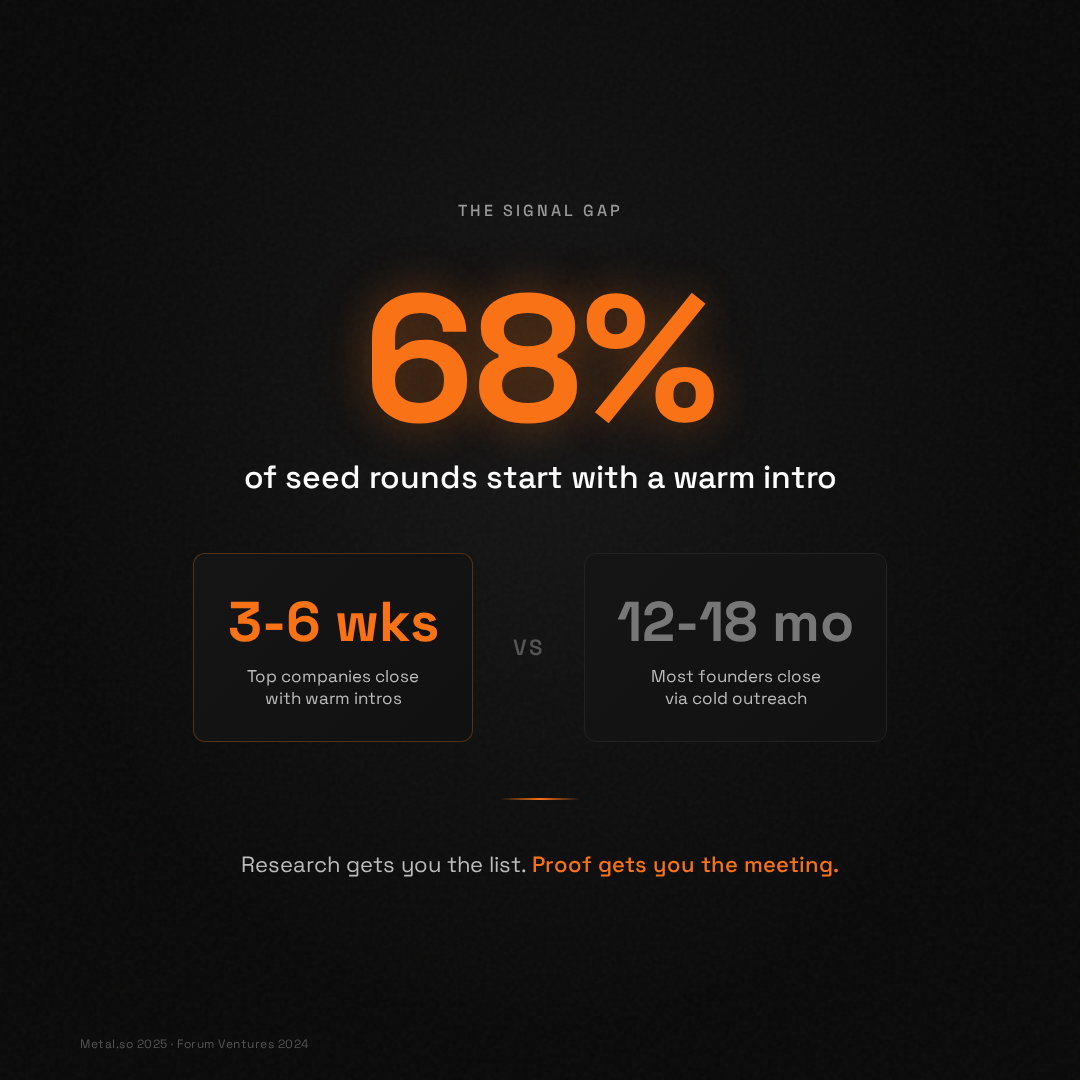
Forum Ventures surveyed 150 active North American VCs and analyzed over 300 B2B SaaS pre-seed and seed deals closed between January and October 2024. It tells founders to plan for a six to nine month process, and reports the average gap between seed and Series A stretching to more than two years in 2024, up from 1.7 years in 2019. The same Waveup study puts the spread more starkly: raise cycles run 12 to 18 months for most founders, against 3 to 6 weeks for the companies at the top of the market. The gap comes down to targeting precision and pre-built proof.
What Investors Are Actually Screening For
Here is what most founders miss. In a first meeting a VC is working out whether your startup matches their thesis, their fund structure, and their portfolio strategy. Those are three different filters, and none of them are about you personally.
The bar for a meeting has also moved. Waveup's 2025 VC survey of 56 funds found that round expectations jumped one full stage across the board: pre-seed now expects what used to be seed traction, seed expects what used to be Series A traction (Waveup, 2025 Fundraising Study). Net Revenue Retention has emerged as a metric VCs check early. Any cold pitch that does not anticipate the new bar gets filtered out before the call. Most nos come down to a stage or thesis mismatch with the fund as it is investing today.
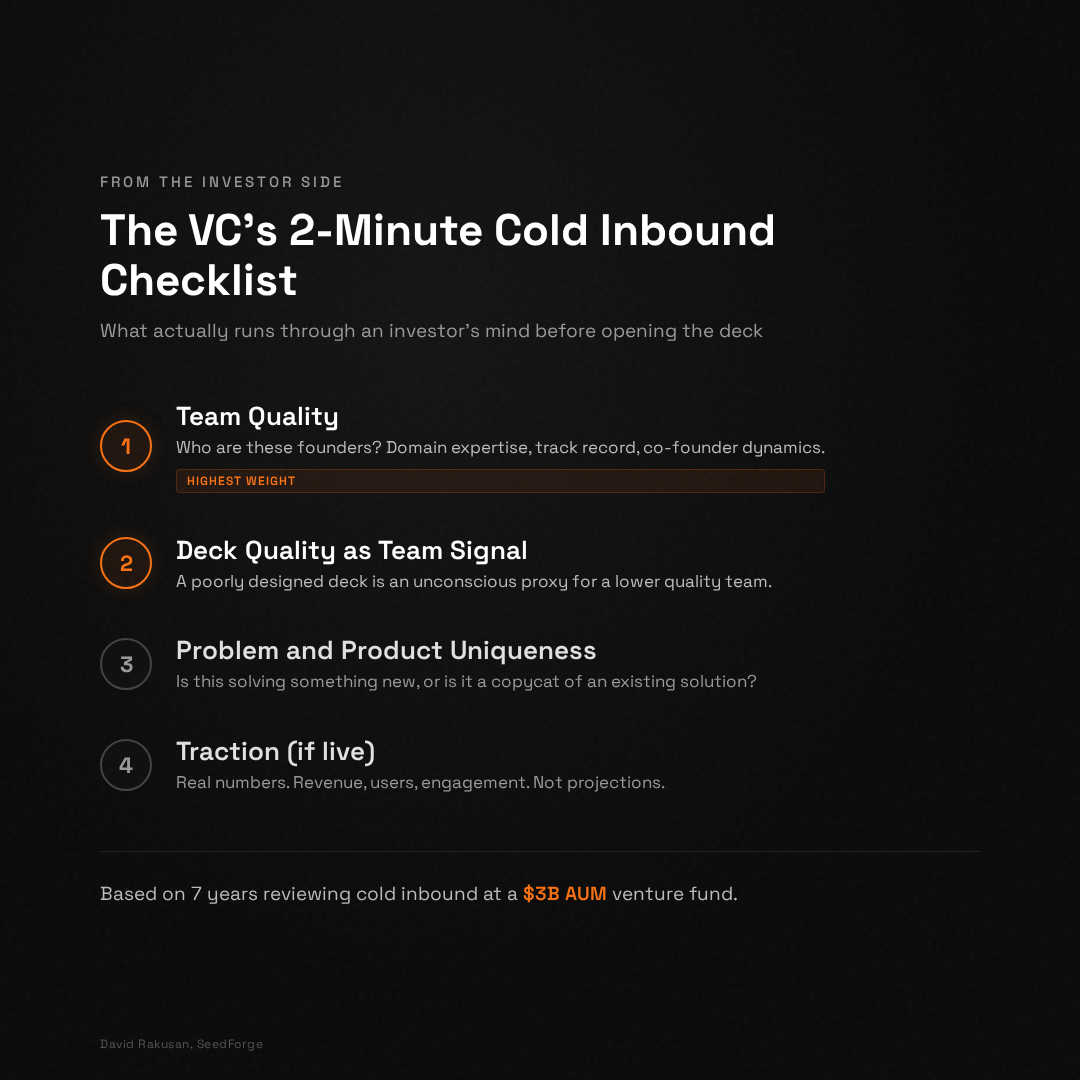
From my own experience on the investor side, cold inbounds almost always felt like spray and pray. Sometimes the pitch was completely outside our sector. We invested in web3, and we would get gaming companies or businesses with zero blockchain relevance. But even when the cold inbound was in our sector, the quality was almost always lower than what came through warm introductions. My mental checklist in the first two minutes of reviewing a cold deal was simple: team quality first, then whether the deck itself was well structured (a poorly designed deck was an unconscious signal of a lower quality team), then whether the problem and product were actually unique or just a copycat. And finally, if the product was live, how much traction it actually had.
That personal checklist is backed by the data. A study in the Journal of Business Economics, a choice-based conjoint study of 564 individual VC investors, found that decision makers with an engineering background prefer startups with break-even profitability and weigh the management team less heavily, while those with a natural science background are drawn to the value added by the product itself. Higher-educated VCs put more weight on international scalability. VCs with entrepreneurial experience weight growth potential and team resilience more heavily.
This means two VCs can look at the same startup and reach completely opposite conclusions. Not because one is wrong. Because they are applying different frameworks shaped by their own backgrounds.
I saw this firsthand. At our fund, we had one GP with a deep technical background and another with a business background. They had very different reads on the same deals. The technical perspective was important because it helped us understand what was actually hard or easy to build. But the disagreement was not always obvious upfront. It surfaced during internal discussion, when we started debating, playing devil's advocate, and looking at the deal through different lenses. Evaluation styles sit on a range from intuitive to scientific-rational, and which end a partner sits at changes what evidence lands with them. Most funds lean toward the intuitive end, which means the same pitch can get a term sheet from one fund and total silence from another.
So when a founder walks into a meeting without understanding the investor's thesis, check size, portfolio composition, and evaluation style, they are essentially presenting proof to a jury without knowing what the jury considers evidence.
The VC Fit Framework: Five Filters Before You Pitch
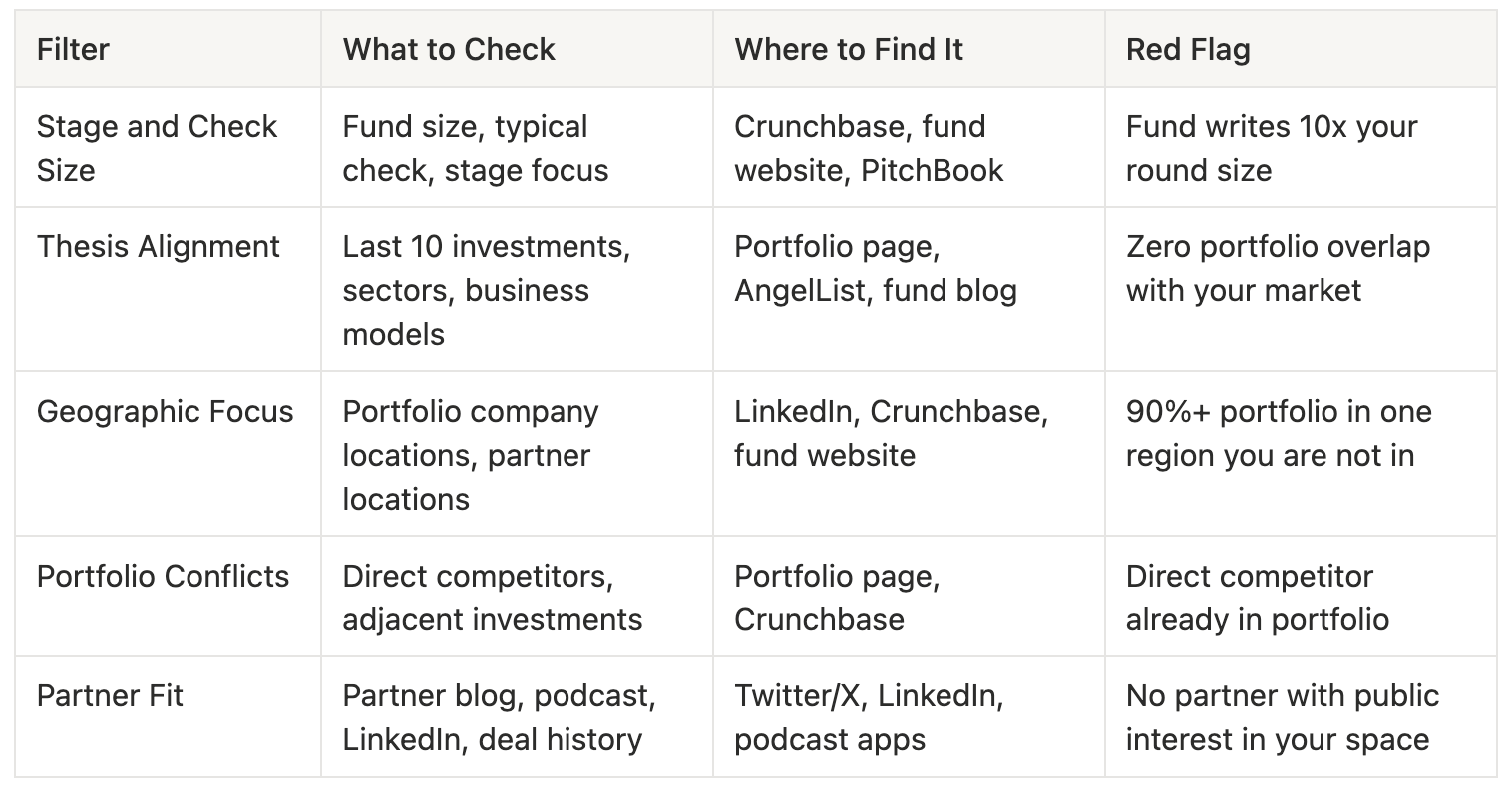
Before you send a single cold email or request a single warm intro, run every potential investor through these five filters. Each one eliminates mismatches that would have wasted your time.
Filter 1: Stage and Check Size
This is the most basic filter and the one founders skip most often. A fund that writes $5M Series A checks will not lead your $500K pre-seed SAFE. A micro fund with $20M under management cannot write $2M checks. Check the fund size, typical check size, and stage focus. If any of these do not match your round, move on.
Filter 2: Thesis Alignment
Every fund has an investment thesis, even if they do not publish it clearly. Read their portfolio page. Look at their last 10 investments. If you cannot find at least 3 portfolio companies that share your market, business model, or technology stack, the thesis does not align.
Filter 3: Geographic Focus
Proximity bias is real and measurable. Fu and Taylor's NBER study, covering roughly 21,000 US deals, found that diligence hours drop by 35% when the geographic distance between the VC and the startup doubles. That does not mean remote deals do not happen. It means that if a fund's portfolio is 90% Bay Area companies and you are based in Prague, you are fighting an uphill battle unless you have a specific connection or an undeniable proof layer.
Filter 4: Portfolio Conflicts
VCs rarely invest in two companies that compete directly. Check the fund's portfolio for direct competitors. If they already back a company that overlaps significantly with yours, they are almost certainly a pass. But also look for adjacent investments. A fund with three companies in your vertical (not direct competitors) signals they understand and care about your space.
Filter 5: Partner Fit
Funds do not make decisions. Partners do. The partner who champions your deal inside the fund is the one whose conviction matters. Research which partner focuses on your sector. Read their blog posts, podcast appearances, and LinkedIn activity. The partner's personal thesis within the fund's broader thesis is what determines whether your deal gets past the first meeting.
The Warm Intro Math Problem
Even with perfect targeting, most founders hit a wall: they do not have enough warm paths to the investors who match.
I experienced this myself. My network was in crypto and web3, where I had spent 7 years. Plenty of VC connections there. But SeedForge is a general tech and AI company, so most of those connections were thesis mismatches for my own raise. I had to expand my network outside of web3, where my connections were far more limited.
Here is the math that makes this hard. One warm connection might intro you to two or three VCs. So to get in front of 40 or 60 aligned investors, you need more warm paths than most founders have. And even when you know a fund is a great thesis fit, you might not have a connection who can get you in the room.
This is the double problem that most fundraising advice ignores. Finding which investors are a thesis fit is hard enough. Getting in front of them without the right connection is harder. Founders need to do their own diligence on investors before asking anyone for an introduction. That research takes real effort, but it is the only way to make your limited warm paths count.
And here is where most "find the right VC" guides stop. They assume that once you have the right list, the meetings will follow. They will not. Research gets you the list. Proof gets you the meeting. A perfectly targeted cold message with structured evidence that your startup is real will outperform a warm intro to a misaligned fund.
The Repetition Trap: Why Fit Without Proof Still Fails
Here is where most advice on this topic stops. "Find aligned investors." Good advice. Incomplete advice.
Even when a founder targets the right investors, the fundraising process still grinds because conviction cannot be transferred from one fund to another. Every new investor starts the diligence process from scratch. The same questions about team, market, traction, and competition.
Carta's Q2 2025 data puts the median interval between primary funding rounds at 696 days, about 23 months, against nearly 600 days two years earlier. The stretch comes from a proof bar that went up while the process for establishing proof stayed where it was: live meetings, one at a time, each starting from zero.
Targeting alone does not close the gap. Even when a fund is a perfect thesis match, every partner re-asks the same four categories in their own language: team, market, traction, and competition. The questions are not arbitrary. Each one is a checkpoint against the thesis the partner already holds, and that thesis is itself shaped by the partner's training and prior deals (Venture Capital, Signalling Theory in Early-Stage Equity Financing, 2022).
Warm introductions do a lot of pre-sorting that targeting alone does not. The sourcing data above is the cleanest evidence available on this. Professional networks, other investors and portfolio companies together account for the clear majority of funded deals, and cold inbound from founders for 10%. A warm path is worth chasing because it moves a founder out of the smallest channel and into the largest one, and because the person making the introduction has already done a round of filtering that the investor trusts. Founders who find the right VC but cannot reach them warm inherit the longer cycle. The mechanics of building those paths are covered in our playbook on getting warm intros to investors.
That is why the best founders now build their targeting list and their proof layer in parallel, not sequentially. They still do the thesis and filter work. But they also pre-build the answers that will get asked in every first call, so the investor hears them in half the time. The new fundraising bar rewards arriving pre-sorted. Waveup's Fundraising 2025 study, which asked 56 VCs, found that round expectations jumped one full stage, so pre-seed now expects seed traction and seed plays by Series A rules: what used to be seed-stage traction is now pre-seed, and pre-seed expectations now look like early seed (Waveup, 2025 Fundraising Study). Without proof, even a thesis-fit meeting fails the new bar.
The Proof Layer: How the Best Founders Arrive Ready
The founders who convert aligned investors into committed ones do something specific. They arrive at the first meeting with structured proof that answers the top diligence questions before they are asked. Our guide to what investors look for at seed sets out the five signals investors weigh at seed, and our guide to proving traction pre-revenue covers how founders with no revenue yet build that picture. Not a polished deck. Not a rehearsed pitch. Actual evidence that the claims in the deck hold up.
This is the difference between "we have strong traction" and "here is our Stripe data showing $14K MRR growing 22% month over month, connected live." It is the difference between "our team is strong" and "here is a structured breakdown of each founder's domain expertise, validated by the questions that came up in our AI session."
Once you have narrowed your list to 8 to 12 aligned investors, the next step is building your proof layer before reaching out. SeedForge was built for exactly this moment. One 30-minute AI session asks what investors ask in the first three meetings. The output is a Living Profile: structured answers, real traction data connected via API, and documents in one shareable link. You send that link with your first message. Investors arrive knowing what is real. The first call starts one level deeper. The first 30-minute session is free at seedforge.com.
This matters even more for cold outreach. From the investor side, I can tell you that cold inbound deals automatically started at a lower level of credibility. That was probably wrong. Good deals come through cold channels too. But they are a needle in a haystack, and the investor has no reason to believe otherwise.
Structured proof changes that equation. When a founder reaches out cold but can show rigorous, structured evidence that their claims are real, the cold message starts to carry signal. It is a weaker signal than a warm intro from a trusted connection, and it is often enough to get past the initial "is this worth my time" screen.
The data supports this approach. Affinity's survey of nearly 300 private capital dealmakers found that 85% now use AI to automate daily tasks, up from 76% a year earlier. Bessemer Venture Partners reclaimed 234 hours per analyst after putting AI into its workflows, and 82% of firms now use AI for deal sourcing research. The market is moving toward structured, pre-built proof.
The Investor Research Checklist: 30 Minutes Per Target
Here is what to do Monday morning. Start the free 30-minute session at seedforge.com and complete your SeedForge Profile. Completing the profile unlocks your matched investor list at no charge, scored on stage focus, check size, sector alignment, geographic fit and portfolio conflicts across hundreds of active investors, with a drafted intro per partner. What used to take weeks of manual Crunchbase digging now takes minutes. You will get a shortlist of 8 to 12 targets worth your time this month.
Then spend 30 minutes per investor on the deeper research that no tool can automate. This is the difference between a cold email that gets deleted and a warm intro that leads to a second meeting.
Step 1: Confirm the match. SeedForge handles the five filters (stage, check size, thesis, geography, portfolio conflicts), but review the results yourself. Open each fund's portfolio page and confirm the match makes sense. If something feels off, skip it.
Step 2: Identify the right partner. SeedForge surfaces the fund. You need to find the partner. Read their last 5 LinkedIn posts or their most recent podcast appearance. Note one specific thing they said that connects to your thesis.
Step 3: Find your warm path. Check your network for mutual connections. Alumni networks, accelerator cohorts, co-investors from previous rounds, and portfolio founders are the four strongest intro channels. Remember: warm intros work because the person making the introduction is putting their own reputation on the line. The investor takes the call because they trust the introducer's judgment. That credibility transfer is what powers the entire system.
Step 4: Prepare your proof layer. Before the meeting, assemble structured answers to the top diligence questions: team background and co-founder dynamics, current traction with real data, market size with your specific wedge, competitive positioning with honest weaknesses, and fundraising terms and use of funds. If you can share these in advance via a single link, you compress the first meeting from orientation to conviction.
Step 5: Set a meeting goal. The goal of meeting 1 is to earn meeting 2. Know what proof point you need to land, what question you expect the partner to push on, and what your honest answer is. Founders who go in with "let me tell you about my company" lose to founders who go in with "here is the proof that this is real."
Accelerator data reinforces the value of structured preparation. Roughly 87% of YC companies are still operating, against a typical five-year survival rate near 50% for a mature cohort, a comparison that flatters the younger YC batches, and about 45% go on to raise a Series A against a 33% average, on YC, Harmonic and Crunchbase figures compiled in Lenny's Newsletter (March 2025). The accelerator advantage is the structured process of proving the business is real before pitching investors, with the brand on top of it.
When Fit Is Not Enough: The Pattern Matching Problem
One final note on investor fit. Even with perfect thesis alignment, some founders face structural disadvantages that no amount of research can overcome.
In a controlled experiment reported in Brooks, Huang, Kearney and Murray (PNAS, 2014), 68.33% of 521 participants chose to fund a venture pitched by a male voice and 31.67% chose the same venture pitched by a female voice, with the pitch content held identical. In 2024, only 2.3% of $289 billion in global VC went to all-female founding teams, on Founders Forum Group's 2025 analysis. Pattern matching is real, it is measurable, and it biases the system toward founders who look like the founders who came before.
This is not a problem founders can solve individually. But it is a reason why structured proof matters even more for founders outside the traditional network. When the system relies on pattern matching, the founders who break through are the ones who make their proof undeniable. Not a better pitch. Better evidence.
Team backgrounds, accelerator graduation, and early traction are imperfect predictors of outcomes. Structured proof does not eliminate this uncertainty. But it narrows the gap by giving investors real data instead of assumptions.
Frequently Asked Questions
How do I know if a VC is a good fit for my startup?
Check five filters before pitching any investor: stage and check size match, thesis alignment based on their last 10 investments, geographic focus relative to your location, portfolio conflicts with direct competitors, and partner-level interest in your sector. If any filter fails, the investor is not a fit regardless of how impressive their fund is.
How many VCs should I target in a seed round?
Quality matters more than quantity. Founders who close fastest target 15 to 25 deeply aligned investors rather than blasting 200 cold emails. The Gompers survey found that only 10% of funded deals arrive as cold inbound from company management, with professional networks, other investors and portfolio companies accounting for most of the rest. A tight, researched list paired with the right warm paths outperforms a broad spray every time.
What is a VC investment thesis and why does it matter?
A VC investment thesis is the set of beliefs a fund holds about which types of companies will generate the best returns. It includes sector focus, stage preference, geographic scope, and the fund's view on market timing. Founders who pitch outside a fund's thesis waste both their time and the investor's. Thesis alignment is the single biggest predictor of whether a meeting leads to a second call.
How should I research a VC before pitching them?
Start with their portfolio page to confirm stage, sector, and check size. Read the target partner's last 5 LinkedIn posts or most recent podcast to understand their current thinking. Check for portfolio conflicts with your direct competitors. Search for mutual connections who can provide a warm introduction. This 30-minute process eliminates mismatched meetings and dramatically improves your conversion rate.
Can AI tools help me find the right investors?
AI-powered tools can match founders to investors based on sector relevance, stage compatibility, check size, and geographic focus. But matching is only the first step. AI-powered founder preparation tools like SeedForge produce a structured proof layer before the first investor meeting. The tool runs a 30-minute AI session that covers what investors ask in the first three meetings, connects real traction data via API, and outputs a Living Profile shared via a single link. The result is that investors arrive knowing what is real, rather than spending three meetings establishing the basics.
Why do warm introductions work so much better than cold outreach?
Warm introductions work because the person making the introduction is putting their reputation on the line. They will not intro a bad deal because it costs them credibility with the investor. That implicit vetting is what makes the investor take the call. The Gompers survey puts numbers on the same thing from the investor side: professional networks, other investors and portfolio companies account for the clear majority of funded deals, while cold inbound from company management accounts for 10%. The introduction transfers a small amount of conviction before the meeting even happens.